AI is transforming multiple industries by automating manual tasks and making small decisions at scale. In lending, we’re seeing AI impacting multiple facets of Loan Servicing, and the future only seems to hold more applications for Artificial intelligence. We’re also now seeing multiple applications of AI in the underwriting process where AI “tees up” data and information for the final credit decision.
Below, we’ll cover these key topics in AI lending and discuss the future of AI in lending:
- What AI in lending is, and why it’s mostly commonly used in underwriting
- How much trust lenders are giving AI to make decisions for them
- The most common problems with AI in lending
- The ideal future state of lending AI (and how it addresses those common problems)
What is AI lending, and how is it commonly used?
Artificial intelligence (AI) in lending is most commonly used to better understand user-provided data and make lending decisions faster.
For example, AI can quickly categorize transactions from a bank statement or API-linked bank account into different types of expenses and incomes that lenders need to evaluate. It can also summarize borrower bank statements and business plans to highlight the crucial data for loan decision-making.
This application of AI is incredibly helpful in business-to-business lending and underwriting, where calculations such as Earnings Before Interest, Taxes, Depreciation, and Amortization (EBITDA) must be performed quickly and accurately.
Predicting risk and improving decisioning efficiency
AI is also used to predict risk that isn’t immediately obvious by discovering hidden variables that would take a human hours to find while reviewing bank transactions manually.
A great use case in the merchant cash advance space, for example, is using AI to analyze loss trends by business sector. AI systems can uncover sector-wide or even region-wide loss trends that would be difficult for human reviewers to detect. These trends can better inform future underwriting decisions for new loan applications within those sectors and regions. This could also help inform a lender’s long-term strategy and lead to a healthier portfolio over time.
AI can also empower lending industry data scientists to improve efficiency in their credit decisioning process. Rather than reviewing a large set of application documents and statements manually, an AI model can serve as an extra set of ‘analytical hands’ to conduct the investigative work, helping form an overall picture that shapes credit decisions much faster and more efficiently.
How much trust are lenders giving to AI? Is it making lending decisions on its own?
While companies give AI a lot of power to interpret data, score data, and make suggestions, lenders still don’t trust AI to make their lending decisions.
AI-based lending models still have some issues (more on this below) that make them not trustworthy enough on their own. Plus, the decisions AI makes without human intervention are not transparent enough to be easily explained for regulatory purposes or for debt investor relationship purposes.
In the near future, it may be possible to automate the entire lending process with AI. For now, most companies are choosing to protect themselves by ensuring that a human underwriter or a programmable, controllable systemic process remains involved.
3 Common problems with AI in lending
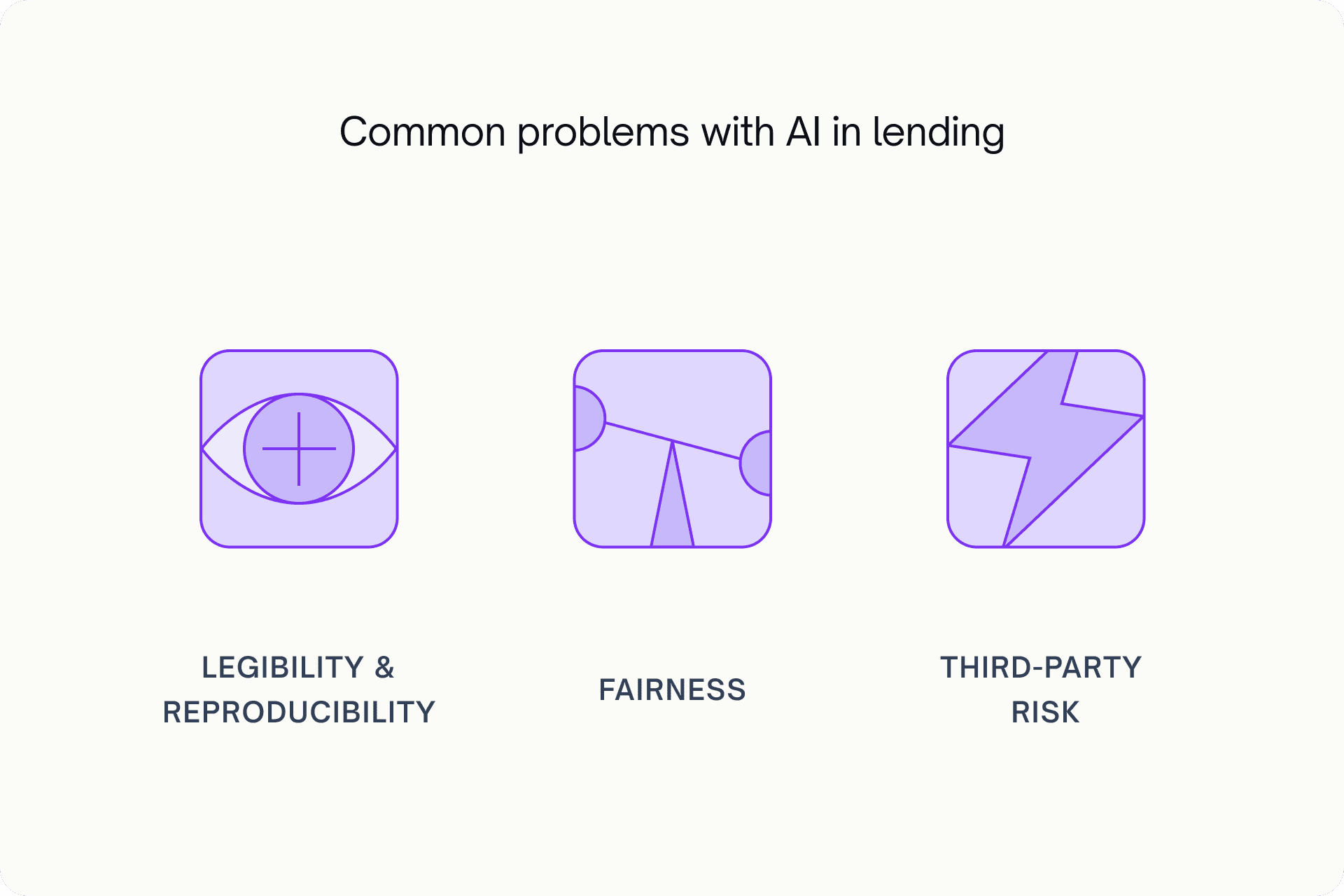
There are three main reasons lenders don’t fully trust AI to automate their lending decisions and instead keep humans in the loop.
1. Legibility and reproducibility
In lending AI, legibility explains why a credit scoring model reaches a particular loan decision. With AI, it’s difficult or impossible to determine legibility, as the AI isn’t easily able to explain why or how it came to its decision.
Moreover, AI Large Language Models (LLMs) interpret inputs differently, leading to disparate, non-uniform decision-making, which is a ripe scenario for regulatory risk. Simply put, AI makes mistakes that aren’t acceptable in lending. Lending decisions must be uniform and perfect to meet expectations from regulators, investors, and third-party advocacy groups.
2. Fairness
With the lack of legibility comes an inherent lack of fairness. Without knowing why an AI model made a loan decision, it’s difficult to ensure that it’s a fair decision. This could be due to existing biases or unfairness in the model’s training data. For example, if training data lacks representation from minority-owned businesses, the model may fail to make fair and accurate predictions for them.
Another risk to both fairness and model accuracy arises when an AI lending model receives input that could lead to biased decisions, such as declining loans to a specific business type (e.g., “food truck-restaurants”). The lack of visibility and inability to intervene in how the AI interprets a business owner’s categorization can lead to inaccurate and unexplainable denials. For instance, an application for a restaurant named “Food for Truckers” might be incorrectly declined because the AI misinterpreted the company as a food truck.
3. Third-party risk
Many lender AI models are managed by a third-party vendor, such as Provenir or Zest AI. Both use machine learning to improve their models with a vast amount of data gathered over time, but this also introduces risk for the lender. For instance, the vendor could change something on the back end or source data that breaks the lending model. Backtesting results become more complicated in this scenario, further affecting problem number one, legibility and reproducibility.
3 obstacles lenders must overcome to make AI models usable
Beyond trust issues, there are several considerations for making AI models usable in the financial services industry, as the data we’re dealing with is exceedingly complex, and mistakes cannot be permitted.
1. Context + expertise are required for evaluations and workflows
Some lenders think you can just “feed” financial data into any LLM and get accurate insights. The truth is that an LLM is only as good as its context window and data layer, and defining these requires domain expertise.
The Challenge: Financial data consists of messy SEC filings, inconsistent fiscal calendars, and complex tables that off-the-shelf models struggle to parse. Hallucinations are unacceptable in finance; they can quickly become million-dollar liabilities.
The Solution: Messy raw data from multiple sources must be turned into a format the LLM can reliably ingest, which requires expertise. There needs to be a ‘normalization’ data layer and workflow that turns messy data into the right context for the LLM to search and parse.
While building and testing the model, experts need to ensure the LLM understands highly specific nuances, such as tickers, SEC filings, and different fiscal periods across companies. Then, the same experts must ensure that the LLM’s output is grounded in reality, as much can go wrong with complex datasets. It must be proven to be repeatedly reliable, or major problems can ensue.
“Anyone can call an LLM API. Not everyone has normalized decades of financial data into searchable, chunked markdown with proper metadata. The data layer is what makes agents actually work.”
– Nicloas Bustamante, CEO of AI portfolio manager, Fintool
2. Deterministic vs non-deterministic outputs
Importantly for lending, most AI models are “non-deterministic”, meaning that they never or very rarely give you the exact same answer twice, even if the changes are slight. But in lending, precision is key. An incorrect revenue figure or a misinterpreted covenant can destroy investor trust. That is why ‘deterministic’ models, or as close as you can get to them, are needed. This can be hacked by giving your AI “skills” and workflows that make them more deterministic.
The Challenge: When dealing with highly sensitive outputs, such as valuations or loan modifications, you need to ensure the answer is always 100% correct. A generic prompt for a complex task often prompts the model to miss critical industry nuances, resulting in small mistakes that can add up to big losses.
The Solution: Bridging this gap requires giving your AI model “skills”. A skill is a simple file that provides your AI model with step-by-step instructions for performing a specific task. For example, you could make a skill with steps for valuing collateral for a secured loan or determining creditworthiness based on cash flow data.
It’s simply a step-by-step file that tells the AI exactly what to do. The results are much more “deterministic” than if you were to focus on better prompt-engineering because the instructions are more detailed and specific.
3. Multi-step agents need a “sandbox” to work in
In a lending environment, an AI agent’s task is rarely a single response. A comprehensive analysis might require searching filings, gathering market data, reviewing credit reports and bank statements, and building a spreadsheet. This is a multi-step workflow that can take several minutes.
The Challenge: These complex, multi-step tasks often require the agent to run code. Having an agent execute code on your servers is a security risk, and long-running tasks are prone to failure if a server restarts or a connection is lost.
The Solution: For AI to actually execute multi-step processes, it needs an isolated “sandbox” environment where the agent can execute code without touching core systems. Essentially, you need a clone of your existing lending systems that the AI can examine and edit at will, without destroying the core systems you rely on.
Beyond underwriting: AI for loan servicing and customer service
Lending AI isn’t just for underwriting. It also has valuable use cases in loan servicing and customer service.
AI for loan servicing
AI can be used to monitor your loan portfolio, identifying high-performing customers who might benefit from additional lending products, as well as those who are struggling and might need extra support. This results in higher lending revenues through strategic marketing to successful customers, but it can also help your bottom line by increasing repayment rates.
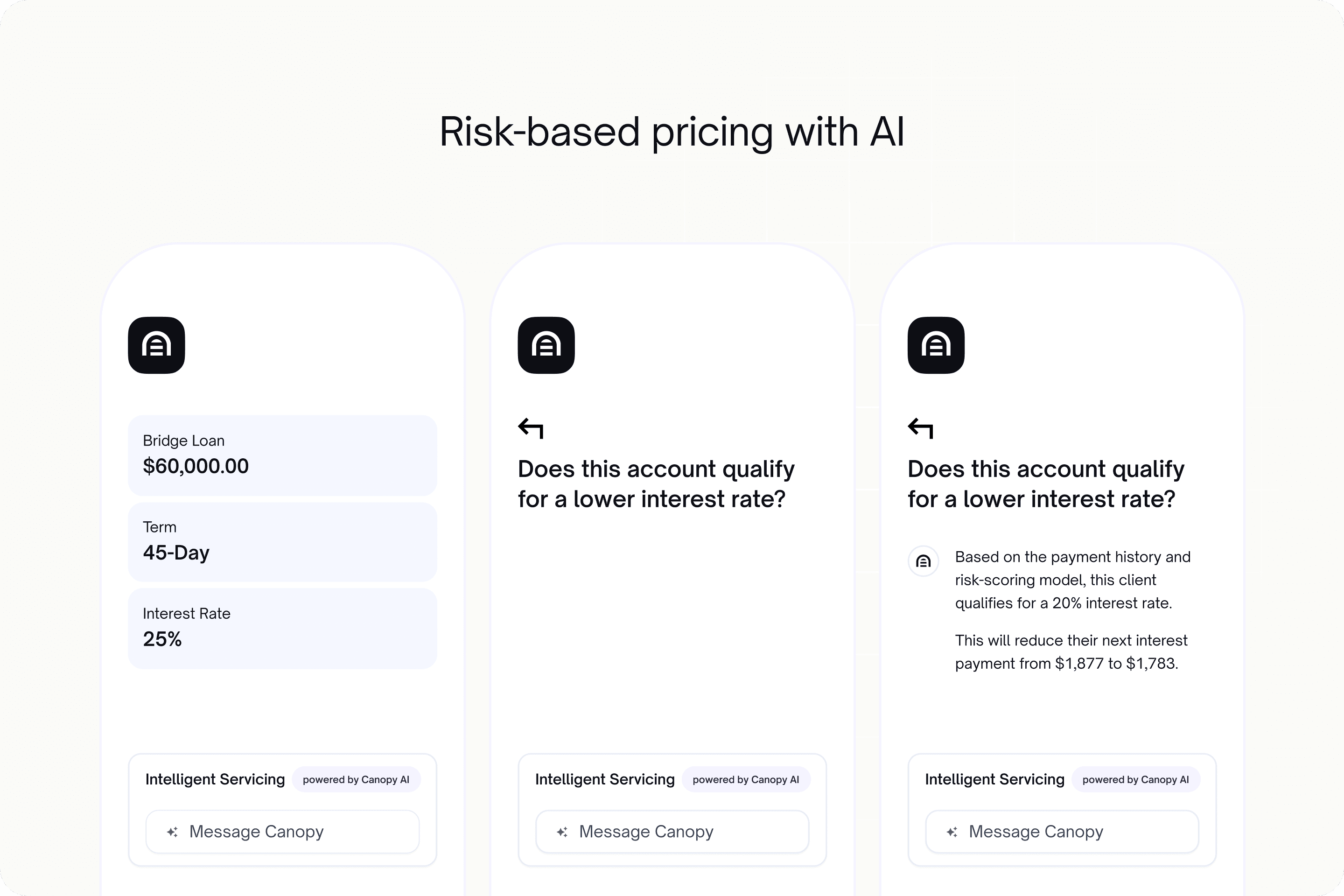
Another part of intelligent servicing is offering newer or higher-risk customers a helping hand to ensure they make their payments on time. Lenders spend countless hours messaging via text, email, push notification, and phone calls to keep higher-risk borrowers on track. AI can use an inexhaustible data set to prioritize helping customers pay their bills when they’re able, combining different channels, messaging, and even languages to find the most effective approach.
Moreover, AI can encourage borrowers to ask for help during hard times. AI-generated messages, delivered at strategic touchpoints in the borrower journey (such as when viewing an upcoming or late payment notice), can prompt customers to contact a lender if they need help repaying a loan. With AI, the messaging can be personalized and tailored to each customer based on their profile and loan information. This can result in shorter delinquency durations and reduced collection costs.
AI could also automatically identify struggling borrowers by analyzing industry trends and geographic data, for example, those in a hurricane zone. Once identified, an AI model could seamlessly reach out via multiple communication channels and offer payment relief or extensions to la arge swath of affected customers.
For customers who accept temporary relief, the AI model (connected via API to the loan management system) can then enact deferral programs or monthly payment reduction. This would, of course, be done with human oversight and approvals, but it offers a fast way to identify at-risk customer segments and reduce overall delinquencies, keeping the portfolio healthier over the long term.
Canopy loan servicing customers who implement flexible repayment solutions like these increase repayment rates by an average of 30%. This means a healthier portfolio, happier customers, and a better long-term business.
AI for lending customer service
Loan servicing requires touchpoints with borrowers for repayment and fulfillment, and for ensuring the loan asset (for secured loans) is performing to expectations. AI can help lenders reduce the cost of all these touchpoints.
Fine-tuned AI chatbots, voice agents, and AI-generated email responses can help borrowers self-serve more often. If 50% of borrowers chose self-service over human-based customer service across a portfolio of millions of credit cards, for example, that would result in tens of thousands fewer borrower touchpoints per month, greatly reducing customer service costs.
Examples of AI lending platforms
Here are some examples of lending companies that offer AI-enabled products today.
Prime
Prime is an embedded lending solution that empowers platforms to offer credit products to their small business customers. It provides the capital, infrastructure, and experience they need to ship these embedded lending products. Prime applies data science and AI technology to better evaluate loan applications in pre-qualification and underwriting. The result is higher approval rates and more customized solutions.
Stratyfy
Stratyfy is a loan decisioning partner to financial institutions. It uses interpretable AI solutions to reduce risk while increasing growth. It can help community lenders, regional banks, and fintech companies reach more customers, expand access to fairly priced credit, and enhance credit decisioning.
Upstart
Upstart is an all-digital lending platform that’s powered by AI. It helps banks and credit unions digitize their consumer lending processes (but not business lending) and deliver a modernized customer experience across personal and auto lending. Upstart’s AI-based credit decisioning model provides instant credit decisions based on a financial institution’s policies and objectives.
While it is unclear whether a human needs to be involved in the credit decision process, it appears that Upstart uses fully automated decisioning for a large share of small-dollar consumer loans.
Canopy
While not technically AI (at least not yet), Canopy offers an intelligent way to manage your loan portfolio. It allows you to connect with AI servicing systems and other platforms to create an operating system for your loan business, enabling you to manage all customer loan accounts in one place.
It also enables intelligent servicing, which creates flexible servicing terms based on pre-determined workflows and conditions. These flexible loan capabilities increase the average repayment rate by 30%.
What does the future of AI in lending look like?
The ideal future state of AI is one in which lenders can unlock AI’s full potential while reducing risk. That means issues like legibility, reproducibility, and fairness have been solved, so fully automated processes can happen without human intervention.
In underwriting, some lenders will “take the plunge” and fully automate the end-to-end loan application process, dramatically increasing decision-making speed. It will also reduce operational costs, remove manual errors, and improve the customer experience by reducing wait times. While there will still be questions about accuracy, regulatory compliance, and complaints, we are sure that some lenders will choose be trailblazers.
After the loan is funded, AI should deliver fully automated, predictive loan servicing. Proactive service messaging will support payment compliance and reduce contact rates. Providing the majority of customer service through AI-driven self-service will reduce service costs and increase the profitability of loan assets.
For the lending industry as a whole, AI should help more companies launch new products with fewer people and lower costs. Fintechs will be able to enrich borrower data more effectively with AI tools, allowing them to create more compelling, personalized products that fill the smaller niches conventional loans can’t reach.
According to Jarrod Parker, Head of Data at Prime, “the ideal state of AI in underwriting is one where we can reap the full benefits of the advanced capabilities with higher accuracy while fully mitigating the consequences.”
Create an intelligent lending program
At Canopy, we can help you create a lending program that leverages our AI-enabled underwriting partners to make faster, better loan decisions, while also using our servicing platform to better serve customers and increase repayment rates. We specialize in helping SaaS providers offering lending products, as well as fintechs and neobanks serving small- to medium-sized businesses.